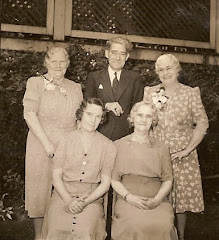
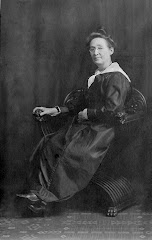
Of course, one might ask, there's one what in every family? And my answer would be, there's one of everything in every family :). But for my re-entry into the world of blogging I am referring to there's one "black sheep" in every family. Here is mine. Or should I say, is this mine?
When I was in school we had to do one of those "trace your family tree" projects that many, if not most, children wind up doing as part of a school project. Only mine didn't come until I went back to college in my thirties! During the course of conversation with my father it'd come out that there were a couple of stories in his family about some serious lawbreakers. One was on my father's maternal line (HODICK) and one on his paternal line. The legend was that a Hodick had been arrested and later hanged in Kansas for stealing horses. The other was that a McHugh ancestor was involved in the Molly Maguires and as part of that activity had been arrested and later hanged.
Now I've found nothing to support the story that a Hodick had been hanged in Kansas for stealing horses. But I did find some references to a Peter McHugh having been involved with the Mollies and had taken part in the murder of Alexander Rae in 1869 (The Trial of the Molly Maguires: A Chronology; Northumberland County Area History: The Molly Maguires). It is unknown if Peter McHugh was an ancestor of ours, but there certainly are a couple of coincidences: Our McHughs were coal miners in NE Pennsylvania. Stories of our grandfather's and great-grandfather's involvement in the Mollies exist across branches of the McHugh line. Certainly circumstantial at best. But enough coincidences to claim a corner of our genealogical brains as research progresses.
As I read different accounts of the trial of Frederick Hester and his co-conspirators to include the above mentioned Peter McHugh I discovered many of my ancestral names surrounding the Northeast Pennsylvania Mollies: McHugh, Doyle, Kehoe and Donahue/Donahoe. The latter three surnames belong to my maternal lines. Perhaps I'm *lucky* and have multiple ones in my family?
Researching black sheep during one's genealogy research can be exciting, but it can also be very difficult. First, families often keep such black sheep a secret, making the process of gathering an oral family history touchy if not downright impossible. Second, you also have to deal with the occasional question of "Why would you want to claim such a character as one of yours?". As genealogists we have to remember that our goal is not to boost ourselves up because of an elite lineage, but to understand the history of our family. History is history.
This article was posted for the 100th issue of The Carnival of Genealogy. Congratulations to Jasia for an amazing feat and thank you for all you do for the geneablogging community.
Sunday, November 28, 2010

Sunday, September 12, 2010
Grandparents' Day 2010
Today is Grandparents' Day in the United States. For me, this day has for far too long meant remembering my grandparents: My longest-surviving grandparent died in 1978, when I was 14 years old. I often find myself a little jealous of my 40-something-year-old friend whose grandmother is still alive with her mind pretty much intact. But the lack of living grandparents means not that I dwell in that jealousy, but that I celebrate the grandparents I knew as a child and the grand- and great-grandparents I never knew.

My paternal grandparents Mary (HODICK) and Joseph McHUGH ca 1925.
Followed by my paternal grandparents 40 years later.


Mary's parents, my great-grandparents Justina (NAHODIL) and Edward HODICK in 1918.

Edward and Justina ca 1950.

My maternal grandparents, Regina "Jean" (DOYLE) and James O'ROURKE, with my mother. Ca 1942.

James O'ROURKE, who died in 1963 before I was born.
My maternal grandmother's family ca 1910. Grandma Jean is believed to be the girl sitting on the matriarch's lap, my great-grandmother Jane/Jennie (McCUE). At far right is my great-grandfather, John J. DOYLE. The others in the photo include my grandmother's siblings Margaret and Blanche, along with some combination of their sons Thomas, Vincent, William, Joseph and James. Anna was likely not yet born.


Labeled as "Ma Doyle, and thought to my my mother's maternal grandmother, Jane/Jennie (McCUE) DOYLE.

My mother's paternal grandparents, Mary (KEARNS) and James O'ROURKE, along with daughters Margaret (Nelly), Mary (Mae) and Betty.


My paternal grandparents Mary (HODICK) and Joseph McHUGH ca 1925.
Followed by my paternal grandparents 40 years later.


Mary's parents, my great-grandparents Justina (NAHODIL) and Edward HODICK in 1918.

Edward and Justina ca 1950.

My maternal grandparents, Regina "Jean" (DOYLE) and James O'ROURKE, with my mother. Ca 1942.

James O'ROURKE, who died in 1963 before I was born.
My maternal grandmother's family ca 1910. Grandma Jean is believed to be the girl sitting on the matriarch's lap, my great-grandmother Jane/Jennie (McCUE). At far right is my great-grandfather, John J. DOYLE. The others in the photo include my grandmother's siblings Margaret and Blanche, along with some combination of their sons Thomas, Vincent, William, Joseph and James. Anna was likely not yet born.


Labeled as "Ma Doyle, and thought to my my mother's maternal grandmother, Jane/Jennie (McCUE) DOYLE.

My mother's paternal grandparents, Mary (KEARNS) and James O'ROURKE, along with daughters Margaret (Nelly), Mary (Mae) and Betty.

My mother's paternal great-grandparents Bridget (DONAHUE) and John KEARNS with their children Mary, Winifred, Genevieve, Lawrence, Jeremiah , John and Francis.
Sunday, September 5, 2010
The Fruits of Their Labor
Labor Day was first observed in the United States in the state of New York, in the city of New York, as a result of a movement put forth by the Central Labor Union. It was celebrated on Tuesday, 5 Sep 1882. The movement to make Labor Day a national observance initially took hold in 1885 and 1886 when municipalities began passing ordinances setting aside the first Monday in September to honor American workers. It wasn't until June 28, 1894 that Congress passed legislation making that day a holiday (U.S. Dept. of Labor).
Labor Day is important to me because my family has always been proud of our history in the American work force. Our ancestors were mostly laborers who worked hard. My paternal lines from Nanticoke, Luzerne County, PA were generally coal miners, though the military and hotel fields were also a part of the Hodick line. The McHugh line was made up of more coal miners.

 My maternal lines were often listed in the U.S. Census records as coal miners; however railroading was also in the O'Rourke blood, including my mother's brother, Jimmy, who retired from the railroads. My maternal workers also hailed from Luzerne County, in Pittston.

My parents were also very hard workers. Dad held a variety of jobs throughout his life. In Niagara Falls he worked for several years at a company known as Carborundum, I believe as a draftsman. He's worked as a dispatcher, a beer truck driver, and as office personnel for a furniture company. As children, my brothers' and my favorite of dad's jobs was as a garbage man for Countryside Disposal. This was in the 1970's, in the days when garbage men rode on the backs of the trucks and manually emptied the trash cans into the truck. He came home with the coolest stuff: Binders and portfolios, office supplies, a dishwasher. My mother, I must say, was not the least bit pleased when he brought home a drum set!
 My mother worked in business. In Niagara Falls I can only remember her working for J.D. Calato's, a company that made drumsticks for some pretty darn famous rock 'n rollers! Odd how she hated that drum but brought us home some drumsticks! My middle brother and I loved this job of hers because she brought home stamps from all over the world and Terry and I used to have stamp collections. In Arizona, my mother worked for a hospital, Diamonds (now Dillards), and mostly, for Greyhound Exposition Services as an office manager.
Labor Day is important to me because my family has always been proud of our history in the American work force. Our ancestors were mostly laborers who worked hard. My paternal lines from Nanticoke, Luzerne County, PA were generally coal miners, though the military and hotel fields were also a part of the Hodick line. The McHugh line was made up of more coal miners.


My parents were also very hard workers. Dad held a variety of jobs throughout his life. In Niagara Falls he worked for several years at a company known as Carborundum, I believe as a draftsman. He's worked as a dispatcher, a beer truck driver, and as office personnel for a furniture company. As children, my brothers' and my favorite of dad's jobs was as a garbage man for Countryside Disposal. This was in the 1970's, in the days when garbage men rode on the backs of the trucks and manually emptied the trash cans into the truck. He came home with the coolest stuff: Binders and portfolios, office supplies, a dishwasher. My mother, I must say, was not the least bit pleased when he brought home a drum set!

Saturday, August 14, 2010
Saturday Night Genealogical Fun: Place Lines
Randy Seaver of GeneaMusings, known for many things genealogical, has a fund topic for tonight's Saturday Night Genealogical Fun: Place Lines. This is much like a Time Line that shows where people were at any given time in history, only this time we'll pick someone on our tree to trace the places that were important to them over time.
I should choose myself since I certainly know most about where I was over time, and since I just added a new place for myself in history. But in order to refocus myself on my genealogy, I'm going to choose the Hodick family. Some will be speculation, some will be known.
Edward Hodick is believed to have been born in October of 1867. Oral family history told the tale of his birthplace as Bavaria. However, the 1900, 1910, 1920,and 1930 U.S. Census records identify Austria/Bohemia as his place of birth.
A passenger list for the ship Pennland in 1885 lists an Edward Hodick, age 18, traveling to "Tomhicker" Pennsylvania with a Franz and Anna Hodick and other Hodick children. It is believed but not proven that this Edward Hodick was my great-grandfather.
We do know that as of Census time in 1900, Edward Hodick and his wife Justina and their four children were living in Washington Township in Crawford County, KS. Edward's occupation was listed as coal miner. The family remained in Kansas at least until 1910, as this year's Census finds the family in Frontenac, also in Crawford County, KS. Interesting to note is the fact that Edward's occupation in this year was listed as a farmer; most other records indicate that Edward was a coal miner. Their oldest son, William, married a Clara and lived for a while in Frontenac. It is believed that at some point he made his way back to PA, then went off to California.
By 1918 the Edward Hodick family was living on Prospect St. in Nanticoke, Luzerne County, PA.
1920 finds Edward and family on Front Street in Nanticoke while in 1930 they were found on Center Street. At some point between these two census years, Edward owned a hotel business, possibly on Market Street.
At some point after 1930, the Hodick family, at least in some portion, migrated to Niagara Falls, NY.
To this date, members of the Hodick family remain in Northeastern PA. Their offspring from Mary, my grandmother, spread out from there to Arizona, Nevada, and Georgia.

Kansas ca. 1900-1915. Edward Hodick, believed to be third from left as you look at the picture.

The Hodick family in 1918, Nanticoke, Luzerne Cty, PA. Sitting in front: Sylvestina (Vesta), Edward Jr. Sitting in the middle of second row: Edward and Justina Hodick. Standing in back on either side, l-r: Mary (my grandmother) and Susan. Unidentified males: William, Joseph, Anthony, Thomas and John.
I should choose myself since I certainly know most about where I was over time, and since I just added a new place for myself in history. But in order to refocus myself on my genealogy, I'm going to choose the Hodick family. Some will be speculation, some will be known.
Edward Hodick is believed to have been born in October of 1867. Oral family history told the tale of his birthplace as Bavaria. However, the 1900, 1910, 1920,and 1930 U.S. Census records identify Austria/Bohemia as his place of birth.
A passenger list for the ship Pennland in 1885 lists an Edward Hodick, age 18, traveling to "Tomhicker" Pennsylvania with a Franz and Anna Hodick and other Hodick children. It is believed but not proven that this Edward Hodick was my great-grandfather.
We do know that as of Census time in 1900, Edward Hodick and his wife Justina and their four children were living in Washington Township in Crawford County, KS. Edward's occupation was listed as coal miner. The family remained in Kansas at least until 1910, as this year's Census finds the family in Frontenac, also in Crawford County, KS. Interesting to note is the fact that Edward's occupation in this year was listed as a farmer; most other records indicate that Edward was a coal miner. Their oldest son, William, married a Clara and lived for a while in Frontenac. It is believed that at some point he made his way back to PA, then went off to California.
By 1918 the Edward Hodick family was living on Prospect St. in Nanticoke, Luzerne County, PA.
1920 finds Edward and family on Front Street in Nanticoke while in 1930 they were found on Center Street. At some point between these two census years, Edward owned a hotel business, possibly on Market Street.
At some point after 1930, the Hodick family, at least in some portion, migrated to Niagara Falls, NY.
To this date, members of the Hodick family remain in Northeastern PA. Their offspring from Mary, my grandmother, spread out from there to Arizona, Nevada, and Georgia.

Kansas ca. 1900-1915. Edward Hodick, believed to be third from left as you look at the picture.

The Hodick family in 1918, Nanticoke, Luzerne Cty, PA. Sitting in front: Sylvestina (Vesta), Edward Jr. Sitting in the middle of second row: Edward and Justina Hodick. Standing in back on either side, l-r: Mary (my grandmother) and Susan. Unidentified males: William, Joseph, Anthony, Thomas and John.
Sunday, May 16, 2010
The Company Store

(Photo credit: http://capt.clint.home.mindspring.com/breakers.html)
At the beginning of this series I'd posted a link to Tennessee Ernie Ford singing "Sixteen Tons", a song which laments the life of a coal miner. A mainstay in the song are the lyrics "I owe my soul to the company store". This refers to the lifestyle differences between the mere coal mine workers and the "esteemed" coal mine honchos.
Back in the heyday of coal mining, the mine owners didn't just own the mines, they owned the towns in which they were located. The miners lived in company owned homes, shopped at the company owned store, and, in many ways, were kept hostage by the company itself. Often the miners' pay went straight to the company to pay the rent and heating. Credits were given at the store, which took payment directly from the miners' wages.
Eckley Miner's Village is a prime example of a coal mining town, complete with the company store and a doctor's office. You can take a virtual tour of this popular Pennsylvania "attraction" on the website (the links to the videos were not working for me tonight, but I have seen them before so if a link doesn't work for you, try again later). Eckley is one of my "must-see" spots in PA if I ever make it there for my genealogy trip: My paternal grandmother and her family lived there after they'd returned to PA from Kansas in around 1915.
As we learned last week, miners' pay was generally dependent upon the amount of quality coal they brought in. If there was too much slate in the coal car of a miner, that miner's pay was docked. Given this and the practice of the coal company taking certain deductions from the miners' pay to cover their rent and food, it was really tough for someone to move up and move on; putting money aside was just not an easy thing to do even outside of the low wages to begin with.
But you better believe that if a miner wasn't pulling his weight, it was easy for the boss to get rid of him!
Thursday, May 13, 2010
Why I Love the Internet
My ancestors in the United States, at least those born prior to 1930, were relatively easy to find (sorry for the unintended pun). That is because until the 1930's or so, family members grew up to live near family members, thus limiting the number of different locations in which to look. After the 1930's, however, people started to stretch across the country. First we had relatives move from Luzerne County, PA to the Chicago area. Others migrated to Niagara County, NY. Over time the distances between relatives grew to Arizona, Nevada, and Georgia, and then to Houston and Virginia. With the time that has passed and the distance that has grown, keeping up with my immediate family was rather tough, let alone keeping up with cousins I'd known or meeting cousins I hadn't. This was a big country, after all.
Until the Internet came along. The Internet gives a whole new meaning to the song "It's a Small World After All". Since beginning my genealogical journey I have been able to reconnect with old friends and cousins. Through my Internet adventures here on my blogs, at RootsWeb.com, at Ancestry.com, and through Facebook, I have gained family connections that I hope make my ancestors proud, as second cousins and third cousins three times removed have managed to "meet" and become friends.
This evening I went to the post office to check my PO Box, which I took out after a recent move. As I was walking to my box I was suddenly struck with a blast of sadness as something there ... I don't even know what ... made me think of dad. I had to brush away a tear and I didn't quite know what set it off. But alas, it was short lived. I checked the box and found a key to one of the "package" bins. Inside the bin was a box from a second cousin in Pittston, PA, who found me through her and her son's research several years ago. She'd been reading my blog for quite some time (and I suspect often disappointed in the gaps between posts over the past year or two) and sent me an email about my recent series on the History of Anthracite Coal Mining in NE Pennsylvania. I keep meaning to respond but time seems to escape me.
Anyway, the item in the box that I found inside my the P.O. bin made my tear fade and my face and stomach roar with laughter:


Straigt from the culm bank in Hughestown, PA. Thanks, Joyce. You really made my day. And sorry I've been so negligent lately.
Sunday, May 2, 2010
How the Earth was Won in the Coal Region
The demand for clean coal in the 19th and early 20th centuries was great, and, as learned last week, the coal industry of Northeastern Pennsylvania reached far beyond the reaches of our shores to those of the U.K., Ireland, and Eastern Europe. Immigrants from these regions and more flocked to Pennsylvania to land a job in what is still today one of the more dangerous professions.
Coal mining is dangerous for many reasons. The bulk of the work was done underground in cold, dark, and dank conditions. It was not work for the claustrophobic. The use of explosives brought dangers of its own, plus the added dangers of the earth caving in, water flooding in, and trouble getting out for those caught inside at the time of the incident.
Coal mining was also not always a guarantee of pay. If you were one of the laborers in the mines, setting off explosives and loosening the coal, your pay was dependent upon the amount of coal you brought in, and penalties were steep if the quality was less than what the mine bosses wanted.
Technology wasn't always so complex, but it always made life a little bit easier, a little bit safer, and/or a little more profitable in the long run. The coal mining industry of the late 1800's and early 1900's benefitted from techonology in a way we would scoff at today, but miners underground credited with saving their lives.
Over time, alternate fuel sources diminished the need for coal, and thus coal miners. But the field of coal mining is not dead, as we've been so tragically reminded these past few months and even years. Coal remains a valuable resource; thus there continues to be a need for miners willing to lay it on the line below the earth on which we trod.Next up: The company store!
Subscribe to:
Posts (Atom)