Randy Seaver of GeneaMusings, known for many things genealogical, has a fund topic for tonight's Saturday Night Genealogical Fun: Place Lines. This is much like a Time Line that shows where people were at any given time in history, only this time we'll pick someone on our tree to trace the places that were important to them over time.
I should choose myself since I certainly know most about where I was over time, and since I just added a new place for myself in history. But in order to refocus myself on my genealogy, I'm going to choose the Hodick family. Some will be speculation, some will be known.
Edward Hodick is believed to have been born in October of 1867. Oral family history told the tale of his birthplace as Bavaria. However, the 1900, 1910, 1920,and 1930 U.S. Census records identify Austria/Bohemia as his place of birth.
A passenger list for the ship Pennland in 1885 lists an Edward Hodick, age 18, traveling to "Tomhicker" Pennsylvania with a Franz and Anna Hodick and other Hodick children. It is believed but not proven that this Edward Hodick was my great-grandfather.
We do know that as of Census time in 1900, Edward Hodick and his wife Justina and their four children were living in Washington Township in Crawford County, KS. Edward's occupation was listed as coal miner. The family remained in Kansas at least until 1910, as this year's Census finds the family in Frontenac, also in Crawford County, KS. Interesting to note is the fact that Edward's occupation in this year was listed as a farmer; most other records indicate that Edward was a coal miner. Their oldest son, William, married a Clara and lived for a while in Frontenac. It is believed that at some point he made his way back to PA, then went off to California.
By 1918 the Edward Hodick family was living on Prospect St. in Nanticoke, Luzerne County, PA.
1920 finds Edward and family on Front Street in Nanticoke while in 1930 they were found on Center Street. At some point between these two census years, Edward owned a hotel business, possibly on Market Street.
At some point after 1930, the Hodick family, at least in some portion, migrated to Niagara Falls, NY.
To this date, members of the Hodick family remain in Northeastern PA. Their offspring from Mary, my grandmother, spread out from there to Arizona, Nevada, and Georgia.
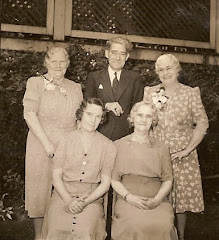
Kansas ca. 1900-1915. Edward Hodick, believed to be third from left as you look at the picture.
The Hodick family in 1918, Nanticoke, Luzerne Cty, PA. Sitting in front: Sylvestina (Vesta), Edward Jr. Sitting in the middle of second row: Edward and Justina Hodick. Standing in back on either side, l-r: Mary (my grandmother) and Susan. Unidentified males: William, Joseph, Anthony, Thomas and John.
Saturday, August 14, 2010
Sunday, May 16, 2010
The Company Store
(Photo credit: http://capt.clint.home.mindspring.com/breakers.html)
At the beginning of this series I'd posted a link to Tennessee Ernie Ford singing "Sixteen Tons", a song which laments the life of a coal miner. A mainstay in the song are the lyrics "I owe my soul to the company store". This refers to the lifestyle differences between the mere coal mine workers and the "esteemed" coal mine honchos.
Back in the heyday of coal mining, the mine owners didn't just own the mines, they owned the towns in which they were located. The miners lived in company owned homes, shopped at the company owned store, and, in many ways, were kept hostage by the company itself. Often the miners' pay went straight to the company to pay the rent and heating. Credits were given at the store, which took payment directly from the miners' wages.
Eckley Miner's Village is a prime example of a coal mining town, complete with the company store and a doctor's office. You can take a virtual tour of this popular Pennsylvania "attraction" on the website (the links to the videos were not working for me tonight, but I have seen them before so if a link doesn't work for you, try again later). Eckley is one of my "must-see" spots in PA if I ever make it there for my genealogy trip: My paternal grandmother and her family lived there after they'd returned to PA from Kansas in around 1915.
As we learned last week, miners' pay was generally dependent upon the amount of quality coal they brought in. If there was too much slate in the coal car of a miner, that miner's pay was docked. Given this and the practice of the coal company taking certain deductions from the miners' pay to cover their rent and food, it was really tough for someone to move up and move on; putting money aside was just not an easy thing to do even outside of the low wages to begin with.
But you better believe that if a miner wasn't pulling his weight, it was easy for the boss to get rid of him!
Thursday, May 13, 2010
Why I Love the Internet
My ancestors in the United States, at least those born prior to 1930, were relatively easy to find (sorry for the unintended pun). That is because until the 1930's or so, family members grew up to live near family members, thus limiting the number of different locations in which to look. After the 1930's, however, people started to stretch across the country. First we had relatives move from Luzerne County, PA to the Chicago area. Others migrated to Niagara County, NY. Over time the distances between relatives grew to Arizona, Nevada, and Georgia, and then to Houston and Virginia. With the time that has passed and the distance that has grown, keeping up with my immediate family was rather tough, let alone keeping up with cousins I'd known or meeting cousins I hadn't. This was a big country, after all.
Until the Internet came along. The Internet gives a whole new meaning to the song "It's a Small World After All". Since beginning my genealogical journey I have been able to reconnect with old friends and cousins. Through my Internet adventures here on my blogs, at RootsWeb.com, at Ancestry.com, and through Facebook, I have gained family connections that I hope make my ancestors proud, as second cousins and third cousins three times removed have managed to "meet" and become friends.
This evening I went to the post office to check my PO Box, which I took out after a recent move. As I was walking to my box I was suddenly struck with a blast of sadness as something there ... I don't even know what ... made me think of dad. I had to brush away a tear and I didn't quite know what set it off. But alas, it was short lived. I checked the box and found a key to one of the "package" bins. Inside the bin was a box from a second cousin in Pittston, PA, who found me through her and her son's research several years ago. She'd been reading my blog for quite some time (and I suspect often disappointed in the gaps between posts over the past year or two) and sent me an email about my recent series on the History of Anthracite Coal Mining in NE Pennsylvania. I keep meaning to respond but time seems to escape me.
Anyway, the item in the box that I found inside my the P.O. bin made my tear fade and my face and stomach roar with laughter:
Sunday, May 2, 2010
How the Earth was Won in the Coal Region
The demand for clean coal in the 19th and early 20th centuries was great, and, as learned last week, the coal industry of Northeastern Pennsylvania reached far beyond the reaches of our shores to those of the U.K., Ireland, and Eastern Europe. Immigrants from these regions and more flocked to Pennsylvania to land a job in what is still today one of the more dangerous professions.
Coal mining is dangerous for many reasons. The bulk of the work was done underground in cold, dark, and dank conditions. It was not work for the claustrophobic. The use of explosives brought dangers of its own, plus the added dangers of the earth caving in, water flooding in, and trouble getting out for those caught inside at the time of the incident.
Coal mining was also not always a guarantee of pay. If you were one of the laborers in the mines, setting off explosives and loosening the coal, your pay was dependent upon the amount of coal you brought in, and penalties were steep if the quality was less than what the mine bosses wanted.
Technology wasn't always so complex, but it always made life a little bit easier, a little bit safer, and/or a little more profitable in the long run. The coal mining industry of the late 1800's and early 1900's benefitted from techonology in a way we would scoff at today, but miners underground credited with saving their lives.
Over time, alternate fuel sources diminished the need for coal, and thus coal miners. But the field of coal mining is not dead, as we've been so tragically reminded these past few months and even years. Coal remains a valuable resource; thus there continues to be a need for miners willing to lay it on the line below the earth on which we trod.Next up: The company store!
Saturday, April 24, 2010
The Lure of .... Coal?
This post is the first in a series that will focus on some aspect of Anthracite Coal Mining in Northeastern Pennsylvania. Today will be a basic history lesson into how this industry transformed the area that lured my ancestors to the New World.
Northeastern Pennsylvania (NEPA) is the number one producer of Anthracite coal in the Western Hemisphere (ExplorePAHistory.com). Anthracite coal is different from bituminous coal as the former is harder and more pure. Anthracite coal was "the" green thing of its day.
But NEPA didn't get it's fame from coal mining without other industries paving the way. In order to make this cleaner burning coal available, it had to be made accessible first to those who would mine and prepare it (and for some, get rich from it) and then to the consumers who would use it. This was accomplished first by the creation of canals that linked the mines to the rivers within the NEPA counties of Carbon, Schuykill, Luzerne and Lackawanna and then to cities in further reaches. The boom of the railroad also was vital to the popularity of anthracite coal,as the rails could reach beyond the scope of the waterways of the northeast region of the United States.
When it became apparent that anthracite coal would revolutionize the heating of America, the corporate honchos with the vision to take advantage of the area knew they would need a labor force that would expand their dream for miserable wages. Immigrants from Scotland, Ireland, England and Germany flocked to the region. After the Civil War, the need grew even more and miners from Poland and Lithuania were brought to the front lines of the Anthracite Coal Mining region. The 1880's brought an influx of miners from the regions of Slovak, Ukraine, Russia, Hungary, Greece, Serbia and Italy (from "Black Diamonds", www.pacoalhistory.com/history/migration.html).
It was during this time frame that my paternal ancestors appeared in the United States, in Luzerne County, Pennsylvania, in the heart of the anthracite coal mining industry. Some came from Ireland, others from within the regions of Hungary and/or Czechoslavakia.
Northeastern Pennsylvania (NEPA) is the number one producer of Anthracite coal in the Western Hemisphere (ExplorePAHistory.com). Anthracite coal is different from bituminous coal as the former is harder and more pure. Anthracite coal was "the" green thing of its day.
But NEPA didn't get it's fame from coal mining without other industries paving the way. In order to make this cleaner burning coal available, it had to be made accessible first to those who would mine and prepare it (and for some, get rich from it) and then to the consumers who would use it. This was accomplished first by the creation of canals that linked the mines to the rivers within the NEPA counties of Carbon, Schuykill, Luzerne and Lackawanna and then to cities in further reaches. The boom of the railroad also was vital to the popularity of anthracite coal,as the rails could reach beyond the scope of the waterways of the northeast region of the United States.
When it became apparent that anthracite coal would revolutionize the heating of America, the corporate honchos with the vision to take advantage of the area knew they would need a labor force that would expand their dream for miserable wages. Immigrants from Scotland, Ireland, England and Germany flocked to the region. After the Civil War, the need grew even more and miners from Poland and Lithuania were brought to the front lines of the Anthracite Coal Mining region. The 1880's brought an influx of miners from the regions of Slovak, Ukraine, Russia, Hungary, Greece, Serbia and Italy (from "Black Diamonds", www.pacoalhistory.com/history/migration.html).
It was during this time frame that my paternal ancestors appeared in the United States, in Luzerne County, Pennsylvania, in the heart of the anthracite coal mining industry. Some came from Ireland, others from within the regions of Hungary and/or Czechoslavakia.
Orphan Photo of girls at a Coal Breaker, possibly from
the Truesdale Mines in PA.
(photo in the collection of Colleen E. McHugh, Tucson, Az)
Next in the series: How the coal was mined.
Saturday, April 17, 2010
I Was Born Coal Miner's Granddaughter
A few years ago I was talking to my father's first cousin Tom. We'd connected not through sharing a history together, having both lived in Niagara Falls, NY, where he still lives, but through the research I've been doing over the years. During this one particular phone conversation Tom had mentioned that he and his wife had gone to Luzerne Cty, PA from where my families hailed. He took a tour of a coal mine while he was there and was telling me how impressed he was with the history involved with coal mining. Several of our ancestors had died in mine accidents, and the tour he took gave him a good understanding of what our cousins and uncles had endured (not to mention their wives and children, who had their own burdens to share). Tom closed his conversation with me with one simple statement: "Colleen, we come from hardy stock".
For some odd reason I found myself rather humbled with the news of recent coal mine accidents in China and in West Virginia. I decided that it was high time some attention was paid to the job of coal miner, so I decided to embark on a little research. I am going to start some research into coal mining with a focus on Anthracite Coal from Northeastern Pennsylvania since that is where my family did their minng. I will include a little history, a little resources on the web, and hopefully a lot of pictures.
I invite my fellow geneabloggers and my relatives who may be reading this to submit to me any photos and/or stories about their families' experiences in the coal mines. If you submit a photo or story, please do so via my email (omchodoy-at-yahoo-dot-com) and include your name as you want it credited in the series, along with any known names in the photos or stories.
While we're waiting for this blog series to begin, I leave you with a musical hero of miners everywhere. Ladies and gentlemen, Mr. Tennessee Ernie Ford. Video available via www.youtube.com, user LordEgan.
Friday, March 19, 2010
In Living Color
I, along with a large percentage of the genealogy community, have been glued to the television on Friday evenings since the beginning of the NBC series, Who Do You Think You Are? (WDYTYA). Each week a celebrity's search for his/her ancestors is featured. The first week they featured Sarah Jessica Parker, and last week it was Emmitt Smith's turn. Great episodes, though I have to admit to wanting to go re-watch Emmitt's since I missed part of it.
But I think that tonight's episode is going to be very hard to beat. Tonight they featured Lisa Kudrow. I'm not sure what made tonight's episode so personal to me, given that I have no known Jewish ancestors and no known link to the Holocaust. But I found myself riveted to the television like I haven't been in a very long time. Tonight's episode was more than a search for someone's family history, it was a search for someone's family story.
Yes, there were stories in the other episodes, and I imagine there will be stories in the episodes to come. But I made a connection with Lisa Kudrow tonight as I watched her travels. One of her comments, while she was in Illya, was to the effect of "This is where she walked, this is what she'd seen when she lived". I found myself brought back to the time, about five years ago, when I was first going through my family's old photographs, in sepia tone or black and white. By the time I finished sorting the photographs and scanning them into my computer I actually had to remind myself that, while the pictures were in black and white, life has always happened in color. I couldn't fathom what these people and places looked like in color.
Ever since this early genealogical time I have longed for the chance to go back to Pittston and Nanticoke in Luzerne County PA so I can see where my grandparents and great-grandparents lived, worked, walked, and played. In true, living color. Perhaps one day I'll get the chance to make that trip. Dare I even dream to go back to the places where my great-grandparents were born and raised? To learn about their lives in their countries and try to grasp the historical basis for their leaving their homelands? I guess maybe this is why Lisa Kudrow's story touched me so deeply ... it was a true search for the story of the people that made her Lisa.
But I think that tonight's episode is going to be very hard to beat. Tonight they featured Lisa Kudrow. I'm not sure what made tonight's episode so personal to me, given that I have no known Jewish ancestors and no known link to the Holocaust. But I found myself riveted to the television like I haven't been in a very long time. Tonight's episode was more than a search for someone's family history, it was a search for someone's family story.
Yes, there were stories in the other episodes, and I imagine there will be stories in the episodes to come. But I made a connection with Lisa Kudrow tonight as I watched her travels. One of her comments, while she was in Illya, was to the effect of "This is where she walked, this is what she'd seen when she lived". I found myself brought back to the time, about five years ago, when I was first going through my family's old photographs, in sepia tone or black and white. By the time I finished sorting the photographs and scanning them into my computer I actually had to remind myself that, while the pictures were in black and white, life has always happened in color. I couldn't fathom what these people and places looked like in color.
Ever since this early genealogical time I have longed for the chance to go back to Pittston and Nanticoke in Luzerne County PA so I can see where my grandparents and great-grandparents lived, worked, walked, and played. In true, living color. Perhaps one day I'll get the chance to make that trip. Dare I even dream to go back to the places where my great-grandparents were born and raised? To learn about their lives in their countries and try to grasp the historical basis for their leaving their homelands? I guess maybe this is why Lisa Kudrow's story touched me so deeply ... it was a true search for the story of the people that made her Lisa.
Subscribe to:
Posts (Atom)